
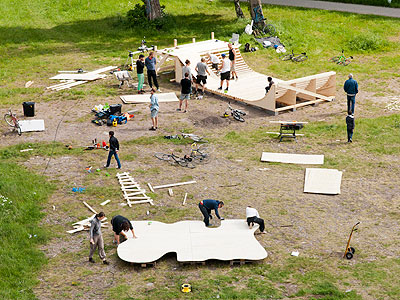
the first outdoor interventions resulting from (Dis)assembled taking place |

[not-yet-planned]
Röda Sten Konsthall, the former thermal plant, sits on a peculiar spot, next to the huge Älvsborg Bridge over the Göta River, literally a few meters beyond the edge of the urban development plan for Gothenburg's waterfront. From this virtual line on, the urban plans are yet uncharted. And although featuring like a desolate field, many have come to like it and use it as a space to hang out along the waterside.

Röda Sten Konsthall – situated just beyond the edge of the urban development plan for Gothenburg's waterfront |
[indoors set...]
As the possibilities for the surrounding
of Röda Sten still remain wide open, with (Dis)assembled,
Röda Sten and STEALTH took a lead to turn the area into a
testing ground. For three months (June – August 2011), we
created a possibility for its users to physically transform
the site. Much of what could be necessary to assemble outdoor
interventions had been prepared – for whoever takes the
opportunity to act, alone or in collaboration.
On the floor of Röda Sten's main exhibition space, people
could find a collection of materials and equipment to go ahead
and give space to their ideas - through a direct, think-on and
hands-on format. Placed meticulously on the floor, stacks of
wood, oil barrels, piles of bags with soil and sand, rolls of
grass, dozens of boxes with screws, hundreds of different
metal anchors for woodwork, stacks of sheet wood in different
thickness, trees, tools and other stuff have been placed.
Amidst these items, one could also find inspiration from a
variety of examples of temporary and D-I-Y spatial
interventions in other contexts. The exhibition featured
videos/slideshows by architecture and art practices like – 72
Hours Urban Action (Bat Yam), atelier d'architecture autogérée
(Paris), Babelgum/Kelly Loudenberg - New Urbanism (New York),
Bruit du frigo (Bordeaux), EXYZT (Paris), raumlabor (Berlin),
Rebar (San Francisco). Finally, Röda Sten Konsthall also
provided assistance from building coaches, for those that get
into action.
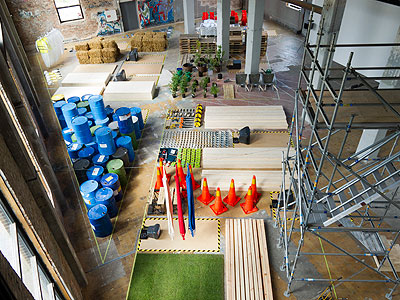
… 2 pallets with 48 bags of sand / 2 pallets with 48 bags of planting soil / 100 wooden beams (45 mm × 70 mm x 3600 mm) / 100 wooden beams (45 mm × 90 mm x 3600 mm) / 300 wooden boards (22 mm × 145 mm x 3600 mm) / 100 plywood 1.22 x 2.44 m x 18 mm / 40 standard euro-size pallets 800 x 1200 mm (used) / 20 straw bales 500 x 500 x 1000 mm / 40 empty barrels / 5 hammers / 1 electric jigsaw / 3 shovels / 5 wheelbarrows / 5 fruit trees (small) / … and much more |
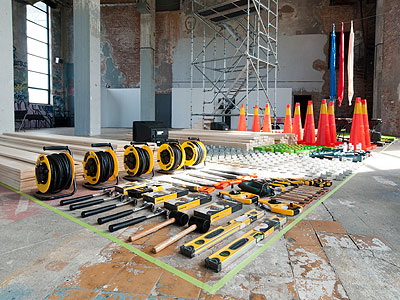
tools, cable reels and anchors |
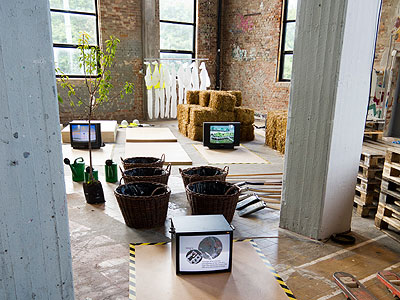
videos showing examples of outdoor interventions by different architects and artists |
[...outdoors action]
Three days before the exhibition
'opening', 10 people have been gathered through an open call
to discuss what is necessary or desired for the site. At the
opening, through the doors of Röda Sten they have literally
taken the materials out to start making the first outdoors
interventions. In just one weekend this varied group (artists,
architects, carpenters, teachers, skaters and kids) made a
skate ramp, a graffiti wall, an aqueduct, seating elements, a
tree hut, in a way that suggests further connection of these
elements over time. At that point we left the process. From
there, for over two months, different groups and individuals
have continued.
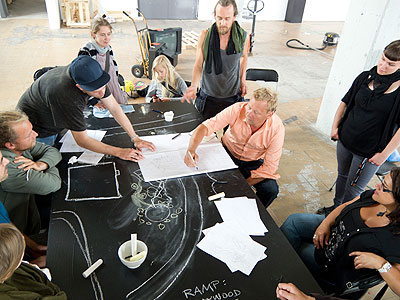
the first group planning their interventions for the site |
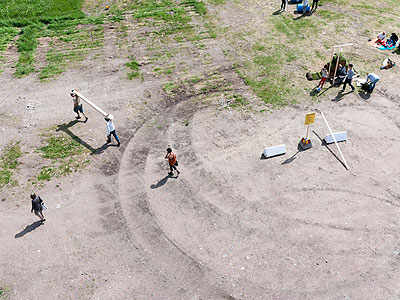
materials being taken out onto the site |
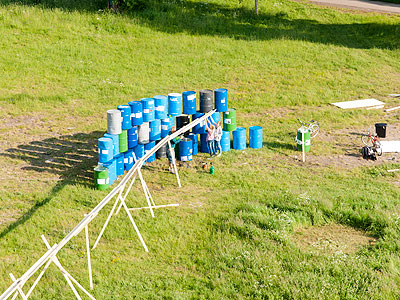
with the help of an aqueduct the new graffiti wall is being filled and stabilized with water |
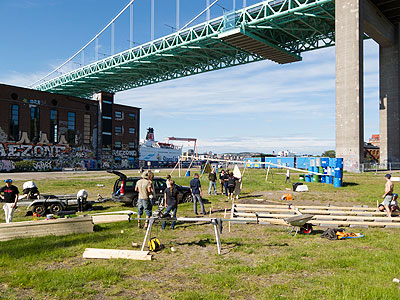
interventions taking place agains the backdrop of the Älvsborg Bridge over the Göta River |
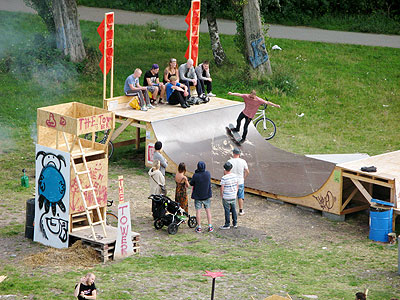
the skate ramp and watchtower |
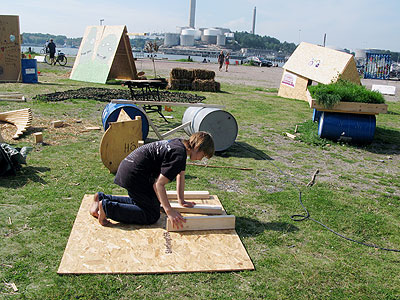
works continuing throughout the summer |
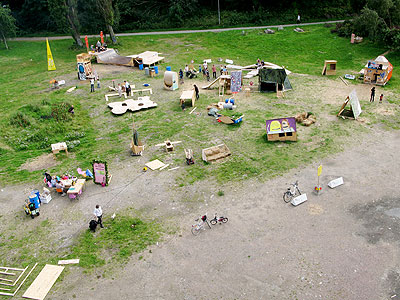
different citizens gathering from day-to-day to participate |
"There were many things that popped up,
other things that were undone for new things to be made. In the
last week there were basically only the TV monitors left in the
exhibition space." (Edi Muka, curator of Röda Sten). (Dis)assembled
attracted about 8000 visitors and participants, and has started to influence the urban planning beyond the temporary. With that, the first step in co-directing the future of this area by its users has been set.
(Dis)assembled has been complemented by a screening
program curated by Edi Muka, with works by Johanna Billing, Chto
Delat, Latifa Echakhch, Mario Rizzi, Stefano Romano and Paola
Yacoub.