|

[dilemma of urbanization]
Urbanization increasingly seems to act like a
self-propelling machine. A staggering urgency to consider the current
development is surely found in the massive and centripetal,
gravitational power of urban growth. For one, in the mega-cities that
have sprung up in recent decades (which differ so much from the
'classic' metropolis that our understanding and tools are at odds with
them) but equally in the massive urbanization that takes place outside
of these megacities.
In the radical new worlds envisioned in the 1960s and 1970s, for the
first time a 'modern' engulfing urban matrix was projected (like in the
works of Constant Nieuwenhuys, Archigram – or in a more dystopian
version by Superstudio, for example) - at a point when
industrialization, space age, computing and the emergence of digital
media converged with the perceived possibility of a fundamental and
liberating 'makeover' of our environment.
Nowadays, while newly arriving citizens cut their ties with the rural
background and become reliant on resources provided third hand, those
that are already part of the urban system have little option to step
out. However, this expanding machine of urbanization may currently be
the only opportunity at hand. For one, because de-urbanization (at the
existing levels of worldwide population growth) may be the most
inefficient, resource consuming and therefore unsustainable future
ahead.
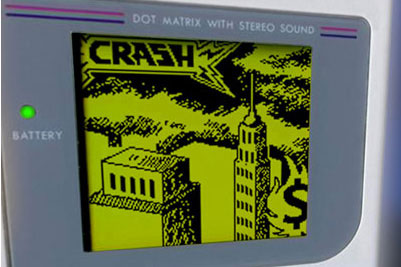
Game Broker by Derivart, 2009. Three retro games for the original Nintendo Game Boy reflecting upon the nature of financial crises |
[exhibition - Opportunities of Entanglement]
The exhibition Opportunities of
Entanglement
touches upon the 'shelf life' or 'expiration date' of contemporary
concepts of the city. It looks at the consequences of the recent credit
crisis versus the boom and decline of Dubai; the flight into web2.0
communities and what that means for our understanding of reality; the
alternative communities making their retreat from the real world trying
to build a sustainable living; the large number of ´refuge'
islands, bomb shelters and luxurious passenger ships ready to be
inhabited by the super rich when 'things go wrong'; the consequences
that mortgage debts from the 'big world' have for the small world of
local communities; the totally alienating industrial landscapes which
have arisen world-wide, and also have been deserted again in many
cases...
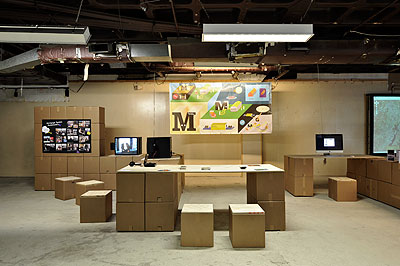
exhibition views at Hoog Catharijne, with works by SMAQ, Francesco Jodice, Kayle Brandon in collaboration with Heath Bunting, Persuasive Games, Bureau d'Etudes, Derivart, The Wildlife Conservation Society, Victor Borisov, Vladimir Todorovic and Justin Tan, Molleindustria, Damon Rich, Information Technology and Innovation Foundation, moddr_/WORM – and Upgrade Cities: samples, made in collaboration with Dubravka Sekulić (photo: Dirk Rose) |
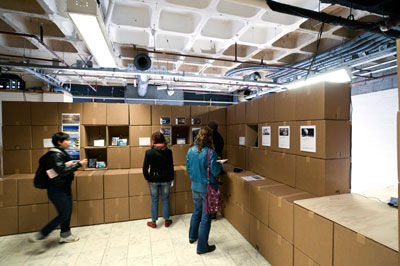
view on part of Upgrade Cities: samples |
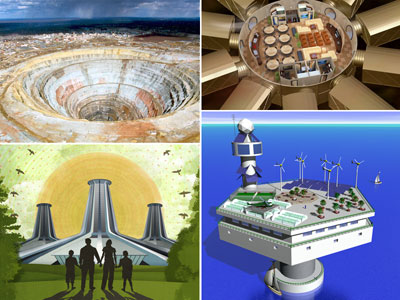
Upgrade Cities: samples / clockwise from left to right: the location for the Siberian eco-city Almaznaya Utopia, a Vivos shelter in the Mojave desert, a proposal for a Seasteading community, and an early image of the Venus project |
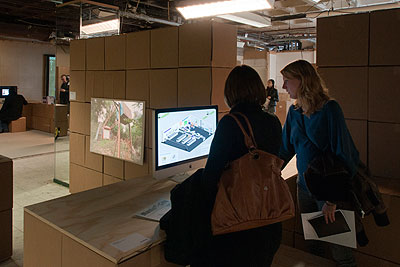
view on The Most Unusual Metro In The World (left) by Victor Borisov and Disaffected! (middle) by Persuasive Games (photo: Dirk Rose) |
For this occasion Matrix City appropriated part
of Hoog Catharijne, Utrecht's 1970s avant-garde shopping center, a site
of past expectations and current demise, which is today regarded
outdated and finds itself on the verge of a major reconstruction.
Reminding in an eerie way of parts of Constant Nieuwenhuys' New
Babylon, a superstructure meant to liberate humans of physical work -
just in Hoog Catharijne one was to find satisfaction in shopping, not
in play.
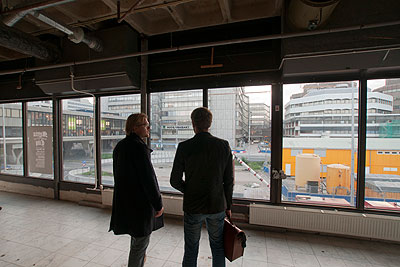
view from the exhibition site at the ongoing reconstruction of the 1970s shopping center Hoog Catharijne |
[7 screening programs]
The screenings at cinema 't Hoogt take us into
seven thematic programs that brought forward 45 works of artists,
filmmakers – but also TV-productions and promotional films. The
works span from 1920's pioneer recordings of the Manhattan (Manhatta,
by Charles Sheeler and Paul Strand), to 1970's avant-garde works of
groups like Italian Superstudio (Supersurface and Ceremonia),
the Chinese 'gold farmers' who currently over the Internet advance US
gamers for a modest amount of money to the next game level (Gold
Farmers by Ge Jin, 2007), up to digital animations, contemporary
community films, Youtube formats, art videos and beyond.
With Promise
of the City, Landscapes
of Production,
Out
of the Machine, Impossible
Possibilities, Adaptive
Survival and Labour
of Play, a picture arises of the
construction of the urban promise, but also of the sometimes grim,
sometimes amazingly beautiful or stimulating reality of the city - the
ambiguity that is so characteristic of the urbanity of Matrix City.
The program concludes with somewhat apocalyptic portrays of the city in
the program Rational
Irrational, that might seem as
overcharged fantasies, but at the same time may come disturbing close
to reality.
In connection to the screening program, a special screening event of
the ongoing Citytellers movie series by Francesco Jodice has
been held, and a talk-show Matrix-Ville: What is Real/Virtual
(see video)
hosted by Peter T. Lang with a number of special guests, including
contributions by some of the original 1970's radical architecture
movement protagonists and invited critics.
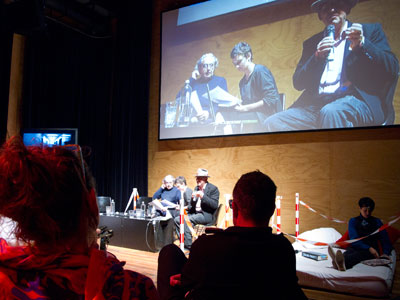
Talkshow 'Matrix-Ville: What is Real/Virtual', with Gian Piero Frassinelli (Superstudio), Saskia van Stein (curator NAi), Tjebbe van Tijen (Imaginary Museum), Piet Vollaard (architect and publicist), hosted by Peter T. Lang (architect and publicist) |
[conference]
Finally, with the two-part conference Superstructural
Dependencies at the Department of Media and Culture Studies of
Utrecht University international practitioners and thinkers have been
brought together to discuss the dependency of urban societies on their
technological superstructures, and in the Virtual flight
panel to investigate the recent developments of virtual urban
environments with their unstable population and continuous
reformulation of their own raison d'etre.
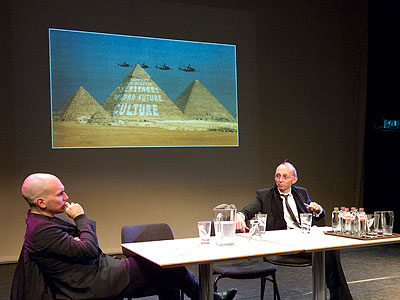
Konrad Becker in conversation with Matteo Pasquinelli during the conference; other speakers included Eric Kluitenberg, Esther MacCallum-Stewart, Ilias Marmaras, Jaakko Stenros and Michiel de Lange |
[newspaper]
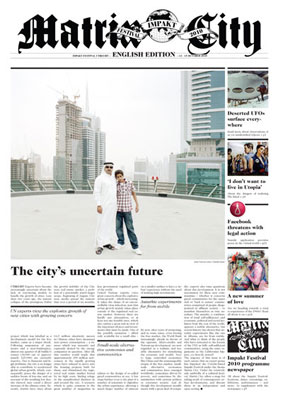
For the festival, the one-off edition of the
Matrix City newspaper has been made with Piet Vollaard and Lotte
Haagsma. The newspaper starts from the artworks and projects presented
within the festival, and connects them with current global urban issues
and dilemmas.